
Spring and Summer all Mixed Up

 Tiny
sweet peas, luscious strawberries, earthy carrots and beets, asparagus,
basil and fresh spring greens. There were so many goodies at the Ottawa's Farmers' Market in Brewer Park this morning I didn't know what to buy let alone decide what to make for lunch and dinner.
Tiny
sweet peas, luscious strawberries, earthy carrots and beets, asparagus,
basil and fresh spring greens. There were so many goodies at the Ottawa's Farmers' Market in Brewer Park this morning I didn't know what to buy let alone decide what to make for lunch and dinner.
The
morning started out with warm sun, then became overcast, then it
rained, then the sun broke through and then the temperature dropped as
the wind whipped up.
One
thing for sure, the weather was as varied as some of the products the
growers had in their stands. Here it was, early June, and some of them
had basil already. Was it my imagination or were the sweet peas and
strawberries are a bit early this year too?
The
vendors straightened me out. It wasn't my imagination. Since last
year some of them had added row covers, greenhouses and hoop houses to
protect their crops and extend the short growing season. These
innovations coupled with an unusually mild winter meant that we would be
able to enjoy fruits and veggies usually available in late June a week
or two earlier. How great is that?
I'm really looking forward to seeing what interesting new dishes come to mind now that the seasons are overlapping so much.
Now, can anyone do something about the weather?


 |
| Mollie the Wonder Dog |


 |
| Pastel duck eggs |


The Edinburgh Farmers' Market

It was cold, it was windy, and it looked like it was going to rain or snow at any minute. But that didn't stop me from checking out the Edinburgh Farmer's Market on our recent weekend getaway to Edinburgh.
Farmers' Markets are my catnip.
Every Saturday, rain or shine, The Market is held from 9:00-2:00 on Castle Terrace in down town Edinburgh with the impressive Edinburgh Castle looming in the background.
On the day we visited, there were about 30 vendors lining both sides of the street. It was jam packed with customers despite the nasty weather. Halfway along, shivering in the cold, I asked two local men if the weather was typical for this time of year. They laughed and replied that I mustn't be from Scotland. Apparently it was considered a balmy, rather pleasant day by the natives. They were both wearing kilts.
Root vegetables, baked goods, breads, fruits, chocolates, meats, whisky, and excellent cheeses where on offer. As always when I visit Farmers' Markets I wished I had a kitchen in my hotel room so I could cook up and enjoy some of their products.
 |
| Whisky and oatmeal. Who knew? |
Hubby's favourite was the Pig's Nose Whisky stand where curiously, he lingered for quite some time, tasting all that they had on offer. We bought one of their mugs when he couldn't decide which of their whiskies he preferred.
A close second was The Chocolate Tree stand, specialists in hand crafted, organic chocolate, where we shared a delicious, creamy hot chocolate.
After about an hour or so, we could take the cold no more and quickly made our way to the Scottish National Gallery to warm up and take in their fabulous collection.
I hope to visit Edinburgh's Farmers' Market again or hopefully another one of Scotland's Farmer's Markets but I think I'll wait until the weather warms up!
 |
| The Edinburgh Castle as a backdrop |
 |
| A wee dram on a cold day |

 |
| Sophie and her smokin' squeeze box |


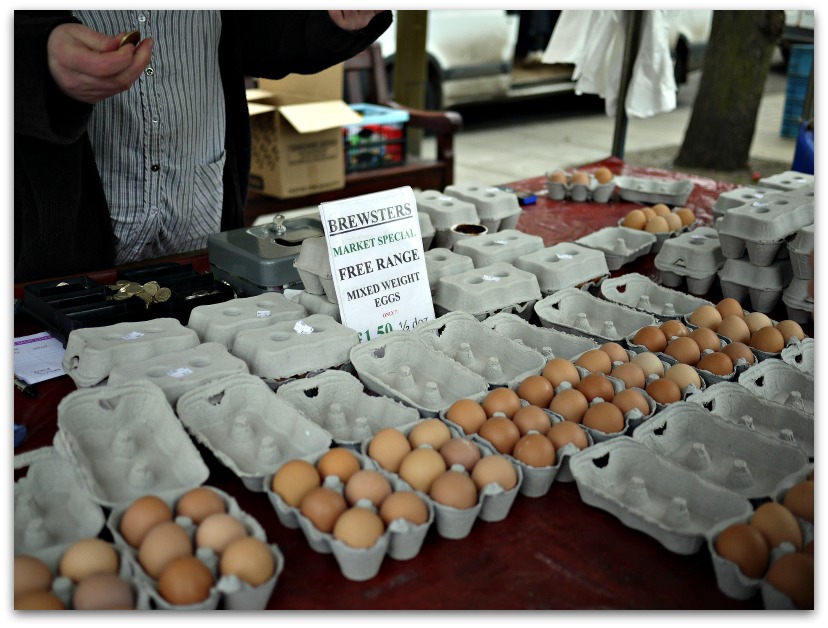


 |
| The Chocolate Tree |
 |
| Stoats' excellent oatmeal |

The Menton Market. An Embarrassment
of Cold Weather Riches
of Cold Weather Riches

 |
| Have your citrus and squeeze it too. |
Everywhere in the Menton market this morning, the cold weather and last week's snowfall was the hot topic of conversation with cries of "Oh la la" this and "mon dieu, il fait froid" that. Everyone was bundled up in puffy coats, gloves and scarves, consoling and praising each other for bravery in the face of such hardship. Even my favourite Vendeuse from nearby village of Gorbio was wearing a fur hat for the first time ever. She, however, was not complaining.
What I found amusing was that amidst all the talk of the cold, wind, and snow, we were surrounded by such fabulous things to eat. Mandarins, lemons, oranges, lettuces, spinach,  broccoletti, artichokes, fava beans, and coco blanc to name a few, all produced locally. An embarrassment of edible riches.
 broccoletti, artichokes, fava beans, and coco blanc to name a few, all produced locally. An embarrassment of edible riches.
  |
| Come on in: a wood fire to keep you warm |
 Seizing the opportunity, someone was selling nifty, mini, plastic, citrus presses to tourists so after they bought their local citrus they could make juice in their hotel rooms and avert catching colds.
After tossing back a quick cup of hot tea, I lugged my grocery cart, heavy with all the goodies, up the hill home and that effectively kept me from noticing the cold.
One thing's for sure, retailers here have their gloved fingers crossed for warmer weather; in two short weeks Menton's tropical Lemon Festival starts.
 |
| A local cold weather crop |
Food Foraging in Monaco

One morning on my daily power walk from our nest in Monaco-Ville to Larvotto Beach, I stopped to stretch out the old hamstrings and something nearby caught my nose that was sweet and enchanting like the smell of candy necklaces mixed with limes. It was obvious where the aroma was coming from. Under the nearby bushes where I had perched my foot, were hundreds of little sage coloured fruits about the size and shape of little eggs. They were Feijoa, a fruit not very well known here but very well known in Brazil where they are native and in New Zealand where they are quite common and used in baking and to make preserves.
Lucky for me, many of the fruit had ripened and fallen under the bushes within easy reach, safely scattered on a soft ground cover. Instinctively, my long forgotten childhood foraging training kicked in.
 |
| My Granny the Forager |
My grandmother was an avid forager and as I child she'd recruit me and my sisters for her little foraging outings. Together we'd collect rose hips from local parks, fiddle heads from forests in the springtime and little wild strawberries which were my favourite. I really didn't see the point nor appreciate her quirky enthusiasm at the time. Like most children I preferred to get all my food from the fridge or the cupboards.
Granny was a big fan of Euell Gibbons, one of America's iconic food foragers and author of Stalking the Wild Asparagus and other wild food guides. Mr Gibbons started foraging as a teenager to keep him and his family from starving. He may have been the butt of many jokes in the 1960's and '70's but look who's laughing now...
According to the The Huffington Post, food foraging is just the next step in the "eat local" craze even though it was simply a matter of survival for humans since the beginning of time. What with the world wide food scene being saturated and seemingly there's nothing new to eat, food foraging is building momentum and becoming fashionable.
Take for example Chef René Redzepi and his ground breaking Copenhagen restaurant, Noma where his menu includes ingredients that have been foraged from Denmark and neighbouring Nordic countries. He was recently awarded the San Pellegrino "Best of the World's 50 Best Restaurants" Award. He must be doing something right. Or interesting. Or both. His dazzling cookbook, Noma includes recipes for dishes like Sea Buckthorn and Beetroot Flødeboller, Bulrushes, Thuja Cones, and Ramsons Leaves. What could be more alluring than that?

I've been known to grab the occasional sprig of rosemary or lavender as I walk by a bush or to return from a mountain hike with some wild thyme stuffed in my pockets but finding those Feijoa kicked it up a notch.

Because Feijoa are so fragile they are not usually shipped which explains why they aren't found in places like Carrefour. In fact, fragility and rarity is one of the top characteristics of foraged food. I've seen Feijoa occasionally being sold by the local producers in the markets in Ventimiglia or Menton but only rarely and in small quantities.
When I got the Feijoa home I ran to my laptop, did some surfing to learn more about them and tentatively sliced a few open to taste them for the first time. Their skin was hard and slightly bumpy and the minute I cut them open I knew what to do with them. They tasted as delicious as they smelt, fruity and sweet and reminded me a bit like guava.
Over the course of 3 days of power walks, I filled my nap sack with them until the fourth day when they disappeared altogether, presumably gathered up by the gardeners and tossed out, fastidious bunch that that are. Or maybe another forager took them.
Over the course of 3 days of power walks, I filled my nap sack with them until the fourth day when they disappeared altogether, presumably gathered up by the gardeners and tossed out, fastidious bunch that that are. Or maybe another forager took them.
Luckily I had gathered about 2 kg, enough to create a new recipe: Fairy Cakes with Feijoa Glaze and Lime Sugar. My Brazilian friend snagged the rest of my foraged bounty to make jam after she smelled them in my kitchen and politely asked to have them.
I noticed last week that the Mairie planted some kumquat trees near the Oceanographic Museum. I wonder if they'd mind.....
Le Beaujolais est Arrivé

According to French tradition, every year on the 3rd Thursday of November the Beaujolais Nouveau hit the store shelves and then the mouths of everyone here in France.
This morning I popped down to our local Carrefour Supermarché to take part in all the fun and I met the friendly and charming people from the Château Le Père Lagrolle who had set up a large display of their Beaujolais Nouveau. When I arrived they were mingling with customers and generally turning a small corner of the supermarket into a light-hearted festival with flying corks and generous cups of wine available to any one who happened to walk by.
The launch of the Beaujolais Nouveau is meant to celebrate the end of the growing season and as a way for vintners to calibrate what's happening with their wines early in the fermentation process. I've always suspected as well, it's a way of bringing some much needed revenue to the Châteaux who produce them.
The launch of the Beaujolais Nouveau is meant to celebrate the end of the growing season and as a way for vintners to calibrate what's happening with their wines early in the fermentation process. I've always suspected as well, it's a way of bringing some much needed revenue to the Châteaux who produce them.
The Italians produce something similar called, Vino Novello and other wine producing regions of France produce their own versions although if they're not from Beaujolais and therefore not an AOC (Appellation d’Origine Contrôlée) they are called simply, Vin Nouveau.

If you're a fan of Beaujolais Nouveau, you should plan a trip to Beaujeau, the capital of the Beaujolais Region in the Rhone. To celebrate the launch of the Beaujolais Nouveau they host a festival called Sarmentelles on the third Thursday of November. The festival is named for the French word for branches, sarments, in this case cuttings from grapevine canes.
No celebration is complete without a big bonfire and piles of sarments are burned in the town square just before the corks are popped and the first glasses of wine are drunk at midnight.
If you've never had Beaujolais Nouveau before you should definitely give it a go but don't expect anything of substance, just lively, perky youthfulness.
It's best to remember the spirit in which it's offered: as an unpretentious, light hearted and optimistic celebration of the end of the growing season.
Santé!


Fabulous Fall Fungi: White Truffles from Alba
 |
| Tuber Magnatum Pico, aka, a White Truffle from Alba with its Cousin, Tuber Melanosporum |
Here on the coast, everyone has switched from pretty, brightly coloured summer clothes to a more sombre, heat absorbing black. Women are winding pretty scarves around their necks to keep out the chill in a way that only French women can.
For me, fall means comfort food like bright green brocoletti, mashed potatoes, porcini and truffles but truffles top my list.
 |
| Outside the Truffle Market |
Every October for many years, my husband and I jumped in the car and made the 4 or 5 hour pilgrimage from Monaco to Alba for the annual Feste del Tartufo which is a definite must at least once in your lifetime and giddy fun for anyone who is fond of truffles and gastronomy in general.
 |
| Certified Truffles from Inside the Truffle Market |
At the centre of the action is the enclosed Truffle Market where thousands of white truffles are on display and for sale. Entering the market is a bit like finding yourself in a heady, crowded, dreamlike orgy. It's an intoxicating sensory memory you'll never forget.
Another of my fondest memories from our trips to Alba was while we were leaving it. After a 3 night stay, we packed the car with truffles and other goodies to share with friends back home and then climbed up the steep staircase back to the hotel to settle the bill. After about 15 minutes, we returned to the car to find it completely surrounded by excited dogs! To me this embodied the powerful and seductive qualities of white truffles.
 |
| Truffles for Sale on the Pedestrian Street in Alba |
For all the hysteria and pretentiousness that white truffles induce, the fact is that they are simply a delicious, rare, fall treat to be generously shared and savoured.
My friends often ask me what to look for when buying a white truffle so I decided to write down and share my top tips. As I point out to them, I'm by no means an expert but after years of buying and serving truffles, here's what I've learned:
 |
| Oh no you din't! |
1. Buy your truffle from a reputable dealer or a dealer who has a permit to sell them. The roadside truffle vendor may be charming and and his prices tempting but unless you are experienced at buying truffles, you may want to just take some pictures and move along.
2. Pick up the truffle and squeeze it between your thumb and index finger. It should be hard and yield a tiny bit. If it's spongy, it's probably overripe. If the vendor won't let you pick up and examine the truffle after you ask to do so, something is definitely fishy.
2. Pick up the truffle and squeeze it between your thumb and index finger. It should be hard and yield a tiny bit. If it's spongy, it's probably overripe. If the vendor won't let you pick up and examine the truffle after you ask to do so, something is definitely fishy.
 |
| Unpretentious Truffles in the Ventimiglia Market |
3. Rub the truffle. It should be dry and smooth, never slippery. If you have powder on your fingers afterwards it's most likely that the nefarious vendor has powdered the truffle with corn flour to make it look fresher and give it a healthy glow. In this case, flee the scene.
4. Appearance. Pull out your glasses if you need them and take a close look. It should be smooth and coloured a mix of grey and tan and free of dark yellow spots, caverns and blemishes. It should be whole and not broken nor cracked. The smoother and rounder and larger the truffle, the better and therefore the more expensive. Do try to find one that is round so it looks pretty when it's shaved over food. Also be on the look out for small stones and dirt embedded in the truffle. You don't want to pay €4,000 a kilo for stones.
5. Smell. Smell all around the truffle, turning it as you sniff but it's definitely a faux pas to let it touch your nose. It should smell a bit like honey and licorice mixed with sweet, earthy sex in the forest. An ammonia smell means it's past its prime. If it doesn't smell pleasant and inciting then it's not a good truffle.
6. Know your prices. Usually truffles hit the market at a high price and then become lower towards the end of the season. Currently they cost around €4,000 per kilo. If you find a truffle you like, have the vendor weigh it, watch his scale and have him quote you the price. A truffle a bit smaller that large marble will weigh about 10 grams, will cost €40 and will serve four.
6. Know your prices. Usually truffles hit the market at a high price and then become lower towards the end of the season. Currently they cost around €4,000 per kilo. If you find a truffle you like, have the vendor weigh it, watch his scale and have him quote you the price. A truffle a bit smaller that large marble will weigh about 10 grams, will cost €40 and will serve four.
Now raise your truffle slicer in your right hand and promise me you'll never buy a preserved truffle - they are a nasty bit of business that should be avoided no matter what anyone says.
 |
| Truffles from Guido da Costigliole Near Alba |
Going to Alba?
If you're planning to go to Alba then lucky you! Here are some of my recommendations:
The place to stay is the San Maurizio in Santa Stephano Belbo, a beautiful drive through priceless vineyards about 20 minutes from Alba. Their spa and Michelin starred, family run restaurant, Guido da Costigliole make it a fabulous place to cocoon and consume copious amounts of truffle. They have a huge selection of Barolos and Barbarescos that pair perfectly with their Piedmontese cuisine. If you're a frequent client, you can store your favourite wines in one of their private cellars for your annual visit.
A stop at the market in Asti on Thursday is a must. There's almost an acre of Italian foods and dry goods vendors to choose from.
The Tourist office in Alba offers courses in truffle hunting and buying. It's a good way to quickly educate yourself about white truffles, especially if you're planning to buy one.
The Langhe Region's Tourism Bureau has an excellent downloadable brochure that describes the complete calendar of events this year's 81st Festival that runs from October 8-November 13th.
Suggested Reading
"Aroma of Truffles" is a really practical guide to white truffles. It explains how they are collected, truffle traditions, recipes, and a helpful and practical resource guide.

 At the esoteric end of the spectrum, "il tartufo d'oro," by Richard Cook, documents the story of a €95,000 truffle, from auction to the dinner table at the Ritz-Carleton in Hong Kong. It's a good yarn with spectacular, alluring photographs.
Stay tuned....truffle recipes to follow!

Italian Supermarket Fun: i Puffi @ Billa

A trip to the Billa grocery store in Ventimiglia these days is even more interesting than usual.
Along with cheap pasta and equally cheap wine, a huge variety of Italian cheeses and great reusable shopping bags, until the end of October there's added incentive to battle the crowds to shop there: the i Puffi promotion.

i Puffi is Italian for the Smurfs and Billa has launched their i Puffi promotion to coincide with Italian opening of the new 3D Smurf movie. As it turns out, Italians are crazy about the Smurfs. Who would have guessed?
Here's how the promotion works. For every €10 that you spend in Billa, you get a packet of 5 i Puffi stickers depicting scenes from the movie. For €3.90 (€2.90 if you're a Billa fidelity card holder) you can buy a really nice hard cover album in which to stick your stickers.
 Of course I bought an album and started pasting in my i Puffi stickers last night and I had a grand time. I even learned a bit of Italian in the process. I'll let you know when it's full.
In some of the packets, lucky shoppers will find special cards for prizes like stuffed Smurfs or vouchers for store credit but the grand prize is what keeps me going back: free shopping at Billa for an entire year. I'd love to win that.
Think of all that free pasta!


Anna Maria's Health Food Shop
 When I became vegetarian at age 17, my mother thought I was just going through another teenage phase so she indulged me by clearing some space in the kitchen cupboards for my little cache of vegetarian basics.
I've always thought of that cupboard allowance as a very supportive gesture on her part considering that she probably saw all of those jars of grains, nuts and seeds as a bit strange.
Well, that seems like a lifetime ago and meat has not crossed my lips since then unless you count an unfortunate pot sticker incident at Harvey Nichols in London 10 years ago.
This may sound strange but whenever I travel I love to explore health food shops, hoping to find fun things that I've never seen before. It's always interesting to see how vegetarian food varies by culture.
In Germany and France for example, along with an astounding array of high quality dairy products, their coolers and freezers are filled with meat-free versions of wieners, burgers and patés in any flavour you can imagine.
Curiously, the French also produce some of the most delicious and high quality soy milk products I've ever had outside of Kyoto.
Curiously, the French also produce some of the most delicious and high quality soy milk products I've ever had outside of Kyoto.
 |
| Naturalia in Ventimiglia |
In general, I have a "give it a try" policy for fake meat products although I've drawn the line at seitan shrimp.
Closer to home, whenever I make my frequent visits to Ventimiglia, I love to pop into Anna Maria di Cane's lovely Naturalia health food shop to buy goodies from her varied prodotti biologici or organic products. As you can see from these photos, she carries a bit of everything and true to Italian culture, a huge array of cookies and crackers made of every grain imaginable. She even accepts special orders and she's always gracious and patient with my limited Italian and willing to speak French when I'm struggling.


Lucky for me, her shop is directly across the street from Ventimiglia's huge produce market so after loading up on all the goodies there, her shop is the icing on the cake: a gluten free, organic one, of course.
Naturalia
Prodotti Biologici
Via Roma 10/A - 18039 Ventimiglia (IM) ITALY
Tel 0184 35 19 19


Prince Albert's Honey

A dear friend of mine and frequent houseguest who knows what a foodie I am, recently surprised me with a rare little something that was manufactured right here in the Principality.
She was one of the few lucky recipients of a jar of the first batch of honey or "Lot 001" from HSH Prince Albert's new private apiary in Monaco's Fontvielle neighbourhood and here it was, on our breakfast table.
After profuse thanks, I grabbed a spoon, dipped it in the jar, and popped it in my mouth. The honey was quite thick, almost resinous, with a fruity but not floral flavour, and a dominant finish of pine. Two words would sum it up: delicious and intriguing.
 Of course the minute I finished licking my spoon I shot over to Fontvielle to see the Prince's apiary for myself.
The Prince has always been ecology-minded, introducing forward thinking green initiatives for the Principality and here was one delicious one underway right within our own borders.
The Prince's rucher or apiary, consists of 6 ochre hives snuggled into a lovely, lush garden on the roof of La Musée des timbres et des monnaies, or Museum of Stamps and Coins, just to the west of the Zoo. It was obvious once seeing the vegetation on the roof top garden why the honey tasted the way it did: It was dominated by umbrella pine trees.

As it turns out, urban bee keeping is taking off world wide. Case in point, amidst the towering skyscrapers of Hong Kong in what must be the world's most hostile environment for bees, designer Michael Leung has become Hong Kong's first urban bee keeper. Mr Lueng founded his company, HK Honey in July 2010 and along with his network of Hong Kong bee keepers they produce enough honey to create an exclusive range of honey based products to keep his shop stocked year round. In true Hong Kong style, he also designs chic hives.
Hopefully the Prince's apiary will continue to be a success and he will make enough honey to sell to others or at least bestow a jar or two upon we humble residents.
I'll be one of the the first in line.

Sospel's Harvest Celebration and Discovering Donkey Milk

So last Sunday when I spotted a flyer for the Fête Agricole Sospel, and after a bit of sweet talk, we jumped in the car and off we went.


Sospel is about 12 km inland from Menton as the crow flies but it takes about 40 minutes to drive there. Why? The road is like a roller coaster, all hairpin curves, up and down mountains through a beautiful forest and past little villages perched on cliffs, some of them enveloped in frothy clouds.
 |
| Display of Local Produce |
With a population of about 3,500 it's a charming and quiet place with little cafes, shops, and the imposing but beautiful Cathedral St Michel which was completed in 1762.
Sospel is also a handy launch point for peaceful and sometimes challenging hikes along the Roya and Bevera rivers. We've often hiked with friends to the pretty little Italian village of Olivetta from here.

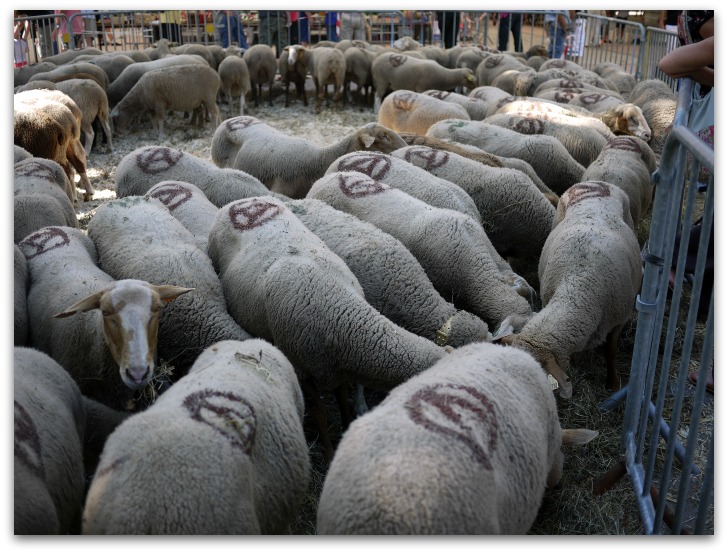 Sospel is also home to my favourite sospellois, or resident of Sospel, Gilbert, who produces reliably fresh eggs and sells them in the Monaco outdoor market. He is one of Sospel's many producers who take advantage of the free irrigation provided by the Bevera river.
As with all little adventures, this one led to a new discovery: lait d'Anesse or donkey milk. The producer, Stephane, makes lovely soaps and creams from his donkey milk which he told us is quite sweet tasting, a bit like almond or coconut and about the same composition as human breast milk.
Apparently, female donkeys produce far more milk than their foals need so the extra sometimes goes to hospitals to be consumed by patients who are lactose intolerant and into cosmetics such as creams and soaps.
Clearly, much more research is needed here and at the first opportunity I'll make a special trip to Stephane's farm to try some donkey milk followed by a post all about it of course.
Apparently, female donkeys produce far more milk than their foals need so the extra sometimes goes to hospitals to be consumed by patients who are lactose intolerant and into cosmetics such as creams and soaps.
Clearly, much more research is needed here and at the first opportunity I'll make a special trip to Stephane's farm to try some donkey milk followed by a post all about it of course.
I think the spirit of the Agricultural Fair generally remains the same world-wide: a showcase and celebration of all the good things that were produced in the season by the dedicated people who produce them.


 | |||||||||||


The Ladies of the Ventimiglia Market
 I returned to the south of France yesterday after my annual summer visit to Canada and the first thing on my foggy, jet lagged mind this morning was the food market in Ventimiglia, just across the French border in Italy. I couldn't wait to get there to see my regular vendors, scoop up their seasonal products and get caught up on the local gossip.
Add to the mix some crazy Italian drivers for whom the centre line is merely a suggestion, and the journey can be a nausea filled nightmare for some but for me it's a thrilling 20 minute chance to imagine what to buy, what to make with it, whom to invite over to share it with and, of course, where the heck to park when I get there.


Driving to Ventimiglia is an adventure in itself. The road is really narrow by North American standards and it curves this way and that, up and down, on the edge of a cliff high above the coast with puffs of iridescent pink and red bougainvillea clinging to stone walls on one side and breathtaking views of the Mediterranean on the other.
 |
| Two of my Favourite Ladies, Barbara and Tiziana |
This early in the fall season, not one particular fruit or vegetable dominates the market scape and a little bit of everything is available. This morning I even saw a few porcini which have arrived a bit early due to July's cool and rainy weather.
The first thing I do when I arrive is bolt to the northeast side of the covered market. It's always my first stop. I've nicknamed this part of the market, "Ladies' Row" since most of the vendors here are women who sell what they grow themselves and what they grow is always fresh, photo worthy and fabulous. Fresh eggs, cheese, olive oil, fruits, vegetables, beans, nuts and whatever else that they found in their gardens, on their trees or in the hen house is on offer. On Saturdays, so many people come here to shop that some of the women bring their husbands, daughters and sons to help them deal with the thick, pushy crowds. I always find this gesture romantic and charming amidst the chaos.
What excited me on Ladies' Row this morning were fresh beans from Pigna, a small pretty, 13th century village inland from Ventimiglia in the Ligurian hills.
Pigna beans arrive here early in the fall and stay for about a month and then poof! Like a phantom they vanish. After that you can only find them dried, in little 200g canvas bags with brown lettering at triple the price of the fresh ones.
As with most things, the fresh ones are better than dried: they taste buttery, sweet, and dissolve in your mouth. I gathered up about 2 kilos of them. After cooking they freeze well...
I also found some tiny, sweet ditterini tomatoes and fresh basil and some Mozzarella di Bufala from my favourite cheese vendor on the far side of the market.
So to celebrate my first day back in Liguria and the south of France I whipped up a simple Insalata Caprese with Fresh Pigna Beans, prepared to capture the best of the season.
Ahhh, it's good to be back.
 |
| "Ladies' Row" on a Quiet Weekday |
 |
| Barbara's Excellent Products |
Pigna beans arrive here early in the fall and stay for about a month and then poof! Like a phantom they vanish. After that you can only find them dried, in little 200g canvas bags with brown lettering at triple the price of the fresh ones.
As with most things, the fresh ones are better than dried: they taste buttery, sweet, and dissolve in your mouth. I gathered up about 2 kilos of them. After cooking they freeze well...
I also found some tiny, sweet ditterini tomatoes and fresh basil and some Mozzarella di Bufala from my favourite cheese vendor on the far side of the market.
So to celebrate my first day back in Liguria and the south of France I whipped up a simple Insalata Caprese with Fresh Pigna Beans, prepared to capture the best of the season.
Ahhh, it's good to be back.
  |
| The First of the Beans from Pigna |
 | ||||||||||||
| Tiny Ditterini Tomatoes |


