Showing posts with label Salads. Show all posts

Tuesday, 20 November 2012

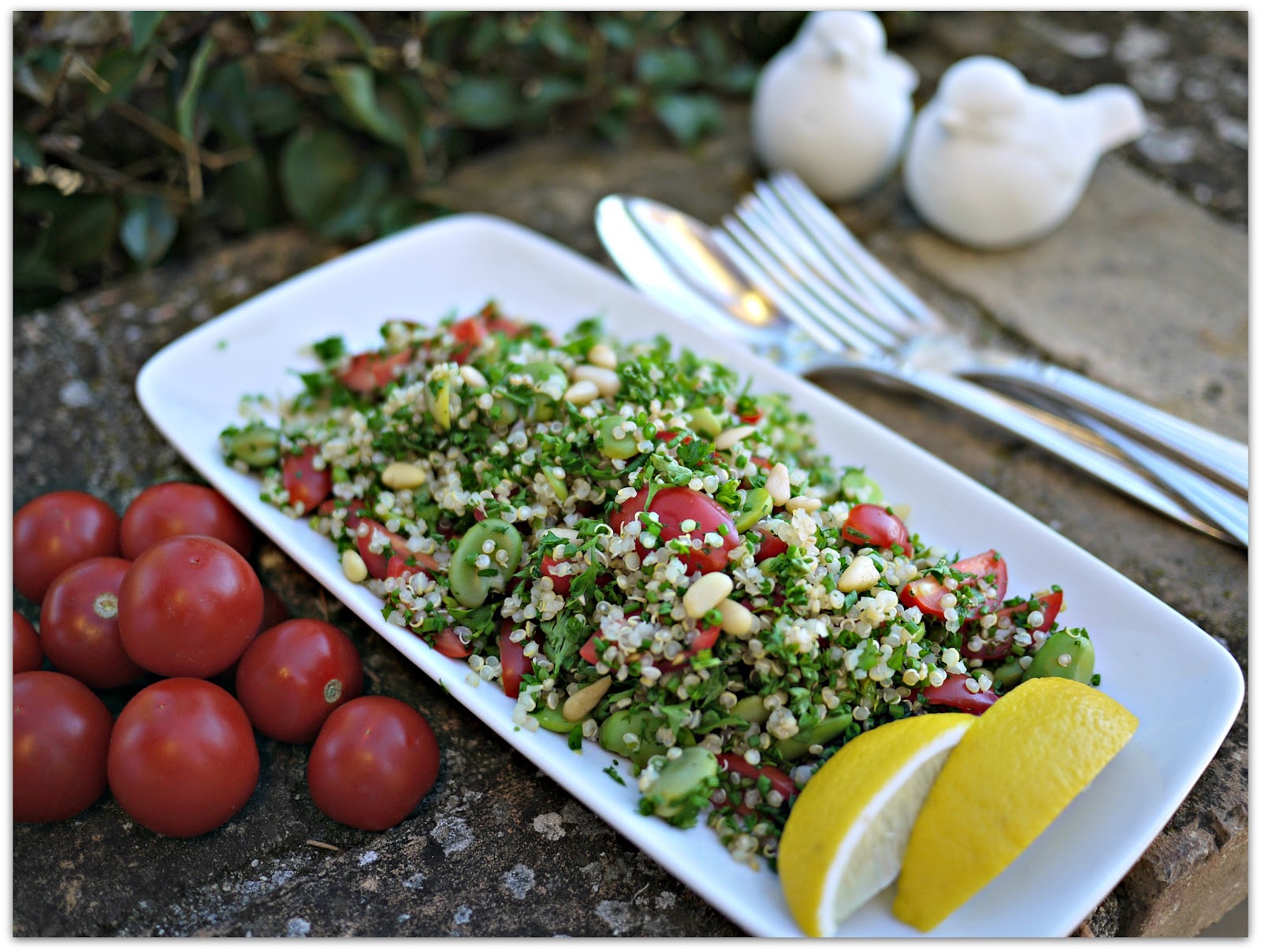
Quinoa Tabouli with Fresh Fava Beans


When I saw heaps of fresh spring fava beans along side fall foods like walnuts, porcini, chestnuts and squash in the Ventimiglia market the other day, I got confused.  Was it spring?  Was it fall?

I often get confused about which season it is here in the Côte d'Azur.  The weather is always temperate so there are always a few spring-like goodies here and there in the local markets even in the dead of winter.  

One thing's for sure, when I do see these bonus fruits and vegetables, I always buy them and prepare something to travel forward or back to wherever they usually belong.  In the case of these fava beans, forward to the spring.  Ahh.


Quinoa Tabouli with Fresh Fava Beans

Serves 4 as a starter, 2 as a main course
Whole fava pods

Ingredients
1/2 cup uncooked quinoa or 1 cup cooked
12-15 whole fava pods
1/2 cup diced tomatoes
1/2 cup chopped parsley
1/4 cup chopped fresh mint
1/4 cup finely chopped chives or green onions
2 tablespoons pine nuts
2 teaspoons of fresh lemon juice
2 teaspoons fruity olive oil
1/4 cup crumbled feta cheese (optional)
salt
pepper

Inner beans after cooking and cooling

Method
1.  Cook the quinoa in salted water until it's al dente.  Pour the quinoa through a sieve and leave it to cool completely.

2.  Remove the beans from the whole pods and boil the inner fava beans for about 6 minutes in heavily salted water.  Drain and blanch by covering them in cold water with a few handfuls of ice cubes added.  Allow them to cool completely.

3.  Peel the fava beans.  Using a small knife or your fingernail, make a small slit the tough outer skin and squeeze out the soft, tender, inner bean. Set aside.

Peeled fava beans
4. Combine the cooked quinoa, peeled fava, tomatoes, parsley, mint, and the chopped chives or green onion in a medium bowl.  Mix well, add the lemon juice and olive oil.  Add salt and pepper to taste and adjust the seasoning. Stir in the pine nuts.  

5. If you're adding feta cheese, you can crumble it and stir it in or cut it into slices or wedges and place it on top of each serving.

6.  Serve with lemon wedges on the side.

Tips
1.  If you can't fiind fresh fava beans you can substitute edamame.


Saturday, 5 May 2012

Salad of Home Made Goats' Milk Cheese, Tomatoes, Fresh Peas and Mâche


I think the French do a stellar job when it comes to dairy products.  The sheer quantity and variety they produce is astounding and lucky for us they're available everywhere you go.  Even in the tiniest corner store in the tiniest villages and in the truck stops en route to them have a fine selection on offer.

Personally, I never drink milk unless it's poured into a hot cuppa or frothed and added to my Caffè Orzo but I'm always up for tasting anything at least once. For years now, I've been buying fresh milk from Mr Gaborit for hubby's cappuccino to great applause so when I saw Mr Gaborit's new Lait frais de chèvre or fresh goats' milk, I thought I'd give it a go.

Mr Gaborit's organic farm is in Maulévrier in the Maine et Loire Prefecture in the north west of France near Nantes and it's here where he raises his mostly free range goats, cows, and sheep.  His milk is pasteurized but not homogenized, which may explain the extraordinary taste:  sweet, buttery, clean, and creamy.  It makes commercial milk taste bitter and diluted by comparison.

Even though his cows' milk is demi-écrémé or partly skimmed, it tastes and acts like full fat milk.  When you first open a new container there's always a luxurious plug of cream on the top.  I read with delight on the label:  "shake to mix in the cream,"  just like in the good old days.

Call me crazy but the first thing that came to mind after tasting the goats' milk was how good it would taste as a fresh cheese. Luckily, fresh cheese is surprisingly quick and easy to make so off I went.

You can use this recipe to make cheese with any fresh goat milk available where you are or if you can't find goats' milk, you can substitute fresh, full fat cows' milk.  Moo!

 
Salad of Home Made Goat Cheese, 
Tomatoes, Fresh Peas and Mâche


Succulent, intense Merinda Tomatoes.  If you can find them, use them
Makes 2 servings


Equipment
Cheesecloth
Large sieve or colander
Blender
Fine meshed sieve
Salad spinner

Ingredients 

For the fresh cheese:
4 1/4 cups (1 litre) fresh goats' milk
1 tablespoon  plus one teaspoon (18g) plain white vinegar
1 tablespoon water
A pinch of granulated sugar

For the salad:
1/4 cup fruity olive oil
1 cup (15g) fresh basil leaves
Fleur de sel or sea salt
1 teaspoon fresh lemon juice
3-4 small Merinda tomatoes, sliced or cherry tomatoes, halved
3 cups (40g) Mâche
1/2 (75g) cup fresh peas, (about 150g in their pods)
2 tablespoons (16g) pine nuts
1/2 teaspoon lemon thyme leaves, finely chopped
Fleur de sel
Freshly ground pepper

Method

1. Wash and spin the mâche.  Put it in the fridge to crisp up. While you're there, put your serving plates in the fridge too.

Drained curd, ready to be pressed and chilled
2. Make the fresh goat cheese.  Line a sieve with two layers of cheesecloth.  Rinse a large sauce pan with water and leave about 1 tablespoon of water in the pan.  Add the milk and the pinch of sugar.  On high heat, bring the milk to a boil and as soon as begins to rise in the pan turn off the heat and stir in the vinegar.  Let it sit, undisturbed for about 30 seconds, then pour it through your cheese cloth lined sieve.  Once the liquid has drained you'll be left with the curd.  Gather together the cheesecloth and form the bundle into a square or rectangle. Place it on a plate, weigh it down with another plate and place in the fridge to chill and firm up.

3.  Prepare the basil oil.  Bring some unsalted water to a boil and toss in the basil.  stir gently, count to 20 and drain.  Lay the basil out on a clean tea towel or paper towels.  Roll gently to dry.  Place the basil and the 1/4 cup olive oil in a blender and blend on medium speed for 30 seconds.  Pour the mixture through a fine sieve into a bowl or measuring cup, press out as much of the oil as you can.  Set the oil aside.

4.  Boil the fresh peas in salted water for one minute.  Remove with a slotted spoon and place an ice bath.   After they're cold, drain them and set them aside.

5.  Remove the cheese from the cheesecloth and slice into any shape you wish.  Set aside.

Assembly
In a large bowl, gently toss the mâche with half of the basil oil, a squeeze of lemon juice and the chopped lemon thyme. Divide the mâche between the two plates, top with the sliced tomatoes, peas and cheese.  Drizzle with the remaining basil oil.  Sprinkle on the pine nuts, a bit of fleur de sel and freshly ground pepper.

Tips
1.  Don't leave the milk on the stove unattended.  It boils over in an instant and trust me, it'll make a big mess.
2.  I didn't remove the skin from the tomatoes but you certainly can.  It would add a more refined note to your salad. To do so, cover them with boiling water for 30 seconds or dip them into boiling water then plunge them into ice water and leave them there for 5 minutes.  Peel, slice.

Sunday, 29 April 2012

Raw Artichoke Salad with Arugula and Parmesan


If you've ever visited the French Cote d'Azur or Italy's Ligurian coast, you may have seen on local menus a salad called, Carciofi Crudi, Rucola e Parmigiano, otherwise known as Raw Artichoke, Arugula and Parmesan Salad.  Its modest title doesn't really do it justice.

The star of the salad is raw épine or spiny artichokes that are available locally in the fall and spring. To make this salad, their tender interiors are finely sliced and seasoned simply with lemon juice, olive oil, and salt, scattered on top of fresh arugula, then topped with a liberal snowfall of shaved Parmesan.  My friend Meghan and I like this salad so much that whenever we dine in Italy, we always ask if the chef can whip one up for us even if it's not on the menu!

Even though artichokes generally take a bit of effort to prepare and the épine variety are particularly dangerous because of their sharp spikes, don't let that discourage you.  I've posted detailed, step-by-step simple instructions for you to follow.  Of course if you aren't able to find the épine artichokes, but you can find other local ones, by all means use those!
  
For this recipe, I like to use St Michel olive oil from Menton. I find that something magic happens to your taste buds when it's mixed with lemon juice.  If you can't find St Michel olive oil, just use any Ligurian olive oil you can find with a prominent, fruity taste.  Ardoino Fructus is a good one.

I hope you make this salad.  For me, it captures the true essence of Liguria.


Raw Artichoke, Arugula, and Parmesan Salad


Serves 4

Equipment
Sharp knife
24-month old Parmesan.
Melon baller
Vegetable peeler
Salad spinner
Mandoline or Microplane shaving maker

Ingredients
6 cups (75g) arugula
8 Epine artichokes
1 tablespoon lemon juice (about 1/2 lemon) plus 6 wedges
2 tablespoons olive oil
Few pinches of fleur de sel
120g of 24 month old Parmesan for shaving, about 30g per person or enough to make about 1/2 cup of shavings per person.


Method
1. Wash and spin your arugula. Place in the refrigerator to crisp up.
Microplane shaving maker

2. Make the dressing.  In a large bowl, combine the juice from one half lemon, 1 tablespoon of the olive oil and a few pinches of fleur de sel.  Mix a bit and set aside.


As you slice them, add them to the bowl of dressing and toss to coat. This will keep them from oxidising and turning brown.  Repeat with the remaining artichokes.  You can add more lemon juice and oil if you find the slices are not being coated thoroughly.  Set aside.

Assembly and Finishing
Try one of the artichoke slices and adjust the seasoning if needed.

Sliced artichokes mixed with olive oil and lemon juice
Divide the arugula between the four plates.  Squeeze a bit of lemon juice over the leaves and drizzle them with olive oil.  Arrange the artichokes in the middle of the arugula and sprinkle with Parmesan.  Serve with a wedge of lemon on the side of each plate.


Friday, 9 September 2011

Inslata Caprese with Fresh Pigna Beans


If you can't find fresh Pigna beans just use any fresh white bean that's available where you are or use dried ones if you can't find fresh.  Please, promise me you won't use canned beans...

Serves 4

Ingredients
1  3/4 cups (220g) shelled Pigna beans, about 420g in the pod
2 cups small plum, datterini, or cherry tomatoes
1 large Mozzarella di Buffala
5 teaspoons of olive oil, preferably a fruity one from Liguria
black pepper
1 teaspoon fresh lemon juice
fleur de sel
1 small clove of garlic, minced
1/2 teaspoon fresh parsley, finely chopped
10 fresh basil leaves, torn into small pieces


Method

1.  Shell the beans and boil them in salted water (2 teaspoons per 4 cups (1 litre)) until tender, about 25-30 minutes.  If you are using dried beans you should cover them in water and soak them over night.  Next day boil them until tender.  

 2.  While the beans are cooking, blanch and peel the tomatoes.  

Place the tomatoes in a bowl and cover them with boiling water. After 2 minutes, drain and cover them with cold water and a few handfuls of ice.  Let them sit for about 5 minutes and then drain them.  Using a knife, cut a small slice off the stem end and pull the skins off.  They should slip off easily.  If not, repeat the blanching process from the beginning.


Slice the peeled tomatoes in half, lengthwise if you're using plum tomatoes, and toss them in 1 teaspoon of olive oil, a pinch of fleur de sel and then add the torn basil leaves.  Set aside.

3.  Once the beans are cooked, drain them and while they are still warm, mix in about 2 teaspoons olive oil, a few grinds of coarsely ground black pepper and the minced garlic. Add salt and lemon juice to taste .  Mix well and set aside.  Once the beans have cooled completely, stir in the parsley.  Taste the mixture and adjust the seasoning if necessary.

4.  Slice the Mozzarella di Buffala in any bite-sized shape you wish. I cut mine this way:  slice it lengthwise in half and then slice each half lengthwise into four wedges.  Cut the wedges crosswise into 6 pieces.  You should have 48 bite sized pieces.  Add the mozzarella to the tomatoes and toss to coat with the liquids in the bowl.  Adjust seasonings.

5.  Divide the salad and beans amongst the 4 plates as arrange as you wish.  Drizzle with a bit more olive oil and sprinkle each serving with a bit of fleur de sel.


Saturday, 2 July 2011

Mâche with Roquefort, Walnuts and Caramelised Pear

Now that July has arrived and the sky is about to catch on fire, it's time to put away the pots and pans and pull out the salad spinner!

When I visited the Main Street Market today  I spotted something that I rarely see in Ottawa but I see every day in France, a tender, tiny, slow growing green called mâche.  In France you can buy pre-washed bags of mâche for a few euro, even from the most modest of supermarkets.  I bought some Canadian grown mâche (for a lot more than a few euro I might add) and whipped up one of my favourite salads, Mâche with Roquefort and Walnuts. 

The first time I had this salad (without the pear) was in France 11 years ago and I've been making it at home ever since.  As a child one of my favourite snacks was blue cheese spread in the grooves of celery stalks so this salad my grown up version of one of my childhood comfort foods.

Mâche is quite versatile.  It has tender leaves but it's also sturdy so it supports heavier accompaniments that would normally collapse other greens.  Also you can eat the entire plant, roots and all.  Now that's ecological!

Authentic French Roquefort like Société Roquefort is made with ewe's milk, has an official French A.O.C. designation, and it's traditionally matured in caves in the region surrounding the village of Roquefort in South Central France.  Its creamy texture and intense flavour is a good choice for this salad but its admirable provenance aside, I prefer the the flavour and creaminess of the less urbane Saint Agur.  Why not try both and decide for yourself?

Any fresh French or Californian walnut will do but take this advice:  buy them at a bulk food store so you can take a big sniff to make sure they are fresh before you buy them. I've been disappointed too many times buying stale walnuts in sealed bags from evil doers who sell them...